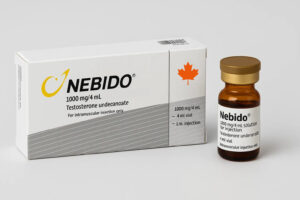
A new long-acting testosterone injection may soon be available in Canada for the first time. Nebido® (testosterone undecanoate), widely used internationally, is expected to enter the market pending regulatory approval.
In February 2026, Apotex announced it had secured exclusive Canadian rights to the drug, with its specialty division Searchlight Pharma handling commercialization.
If approved by Health Canada, Nebido would become the first long-acting injectable testosterone option in the country, with dosing every 10–14 weeks.
That interval stands out. Most patients in Canada inject weekly or every two weeks.
While Nebido will add a new treatment pathway, it’s entering a supply system that is already fragile, with limited redundancy and growing demand.
Canada’s Testosterone Supply Problem
Canada’s testosterone supply has been unstable for years, especially for injectable products. Shortages of testosterone cypionate and enanthate tend to cycle. Health Canada drug shortage reports show recurring disruptions across multiple products, with some entering shortage repeatedly over several years. In practice, when one product goes out of stock, another partially fills the gap before tightening as well. Patients often call multiple pharmacies trying to find their medication, only to be told it’s unavailable. They’re then forced to switch products—a process that isn’t always straightforward—as supply continues to shift.
Depo-Testosterone, Pfizer’s brand of testosterone cypionate, had recurring shortages, including one that lasted nearly two years, before Pfizer discontinued it. Taro now produces a generic version of testosterone cypionate in Canada.
Testosterone enanthate has also been inconsistent across multiple manufacturers. Theramed, Valeant, and Bausch each entered and later exited the market, leaving only two manufacturers today, Hikma and Taro, with limited redundancy between them.
That leaves very little buffer in the system. With just two manufacturers supplying injectable testosterone, any disruption can have an immediate impact, with few alternatives ready to take over. These are older, low-cost generics, with little incentive to build excess capacity.
At the same time, demand is increasing. More people are starting testosterone therapy and staying on it long term. Access has expanded, including through in-person and virtual TRT clinics, which are contributing to increased demand and pressure on the existing supply system.
Nebido is entering a system where supply has been inconsistent while demand continues to grow.
Where Nebido Could Improve Access
Nebido adds a different kind of supply to the system.
Instead of weekly or biweekly injections, it’s typically given every 10–14 weeks. That changes how often patients need refills and deal with pharmacy availability. During shortages, that could mean fewer situations where a refill is due but the product isn’t in stock. While this doesn’t reduce overall demand for testosterone, it may reduce how often patients run into supply issues.
It also introduces a separate supply channel. Nebido is being brought in by a different manufacturer, with its own production and distribution. If patients switch to it, some demand shifts away from cypionate and enanthate.
These changes could improve how the system holds up during shortages by reducing how much pressure falls on the same products, but that depends on how accessible Nebido actually is once it reaches the Canadian market.
Nebido Won’t Solve Testosterone Shortages
Nebido adds a new option, but several factors will limit its impact in the short term.
Cost is the first constraint. Short-acting injectables like cypionate and enanthate are inexpensive and widely covered. Nebido is likely to come in higher. In parts of Europe, Nebido pricing varies but is lower than in the U.S., typically around €70–120 per injection (roughly $100–180 CAD). In the U.S., the same drug (Aveed) has historically been much more expensive, with anecdotally reported out-of-pocket prices around $800–$900 USD per injection (over $1,000 CAD). Canada will likely fall somewhere in between, but pricing is still unknown.
Coverage is a barrier. Provincial drug plans typically move slowly on newer, higher-cost medications, especially when lower-cost options already exist. Nebido will likely require special authorization or be limited to specific cases early on. Without broad public coverage, access will depend heavily on private insurance or out-of-pocket payment.
The way Nebido is administered also matters. Typically, Nebido isn’t self-injected. It’s given in a clinic as a large-volume (3-4mL) intramuscular injection every 10–14 weeks, and needs to be administered slowly by a healthcare provider with monitoring afterward due to the risk of reactions during injection. That reduces how often injections are needed, but it also means relying on appointments and provider availability. In Canada, that creates friction. Healthcare access is already problematic, especially for people without a regular primary care provider or consistent access to a clinic. In rural areas or overstretched clinics, getting an appointment every few months can be difficult.
This is less of a barrier in private, in-person TRT clinics. These clinics already operate around this kind of model, and Nebido is likely to be marketed directly to this segment as a premium convenience option. For patients at those clinics, the administration requirements aren’t a barrier. And because private TRT clinics serve a concentrated, growing patient base, adoption there could meaningfully reduce pressure on the broader cypionate and enanthate supply — which is exactly the kind of demand shift that would actually help.
Adoption will take time as well. Prescribers, pharmacies, and patients are all set up around cypionate and enanthate. Assuming Nebido is approved, it will be added alongside cypionate and enanthate rather than replacing them.
These factors limit how quickly Nebido can scale. It may improve access for some patients, but it won’t resolve the underlying supply issues on its own.
Canada’s Testosterone Market Structure
Short-acting injectables dominate in Canada for a reason. Cypionate and enanthate are inexpensive, widely covered, and easy to prescribe and dispense. They also allow for flexible dosing, making them practical for both patients and prescribers. Over time, they’ve become the default approach.
Nebido is entering a different part of the market. It will likely be positioned as a higher-cost or second-line option, at least initially. Its use will also depend on access to in-person care, since it’s administered in a clinic rather than self-injected.
Public systems also tend to move slowly, especially when lower-cost options are already available. That will shape how Nebido spreads in Canada, with uptake likely concentrated in specific settings, such as private-pay clinics or specialist practices, rather than across the system as a whole.
Key Factors to Watch
Several factors will determine how much Nebido changes testosterone access in Canada:
- Regulatory approval: Approval from Health Canada is likely, but not guaranteed, and timing is still unclear.
- Pricing: Canadian pricing has not been announced and will determine how accessible Nebido is in practice.
- Public coverage: Provincial plans are unlikely to cover Nebido broadly at launch, which would restrict early access.
- Uptake: Adoption will take time and will likely be uneven at first.
- Future competition: Additional generic versions of testosterone undecanoate could lower prices over time, but that’s years away.
Nebido’s Role in Canada’s Testosterone System
Canada’s testosterone system is already under pressure, with inconsistent supply and growing demand.
Bringing Nebido to Canada introduces a new treatment pathway and supply channel.
Cypionate and enanthate will still carry most of the system, but Nebido adds another layer. If it’s accessible and widely used, it could shift some of the pressure away from existing products. If not, it will sit alongside the same access issues patients are already dealing with.
In that sense, Nebido is less a solution and more a test of how well the system can absorb a new option.